

Fransisca has been spending her Saturday mornings in the library, determined to finish the second draft of her novel by the end of the year. She thought she’d be onto her third draft by now, but life had other plans.
With the weight of feeling behind and like she was losing momentum with her writing career, she wandered into the garden that afternoon looking for a little magic.
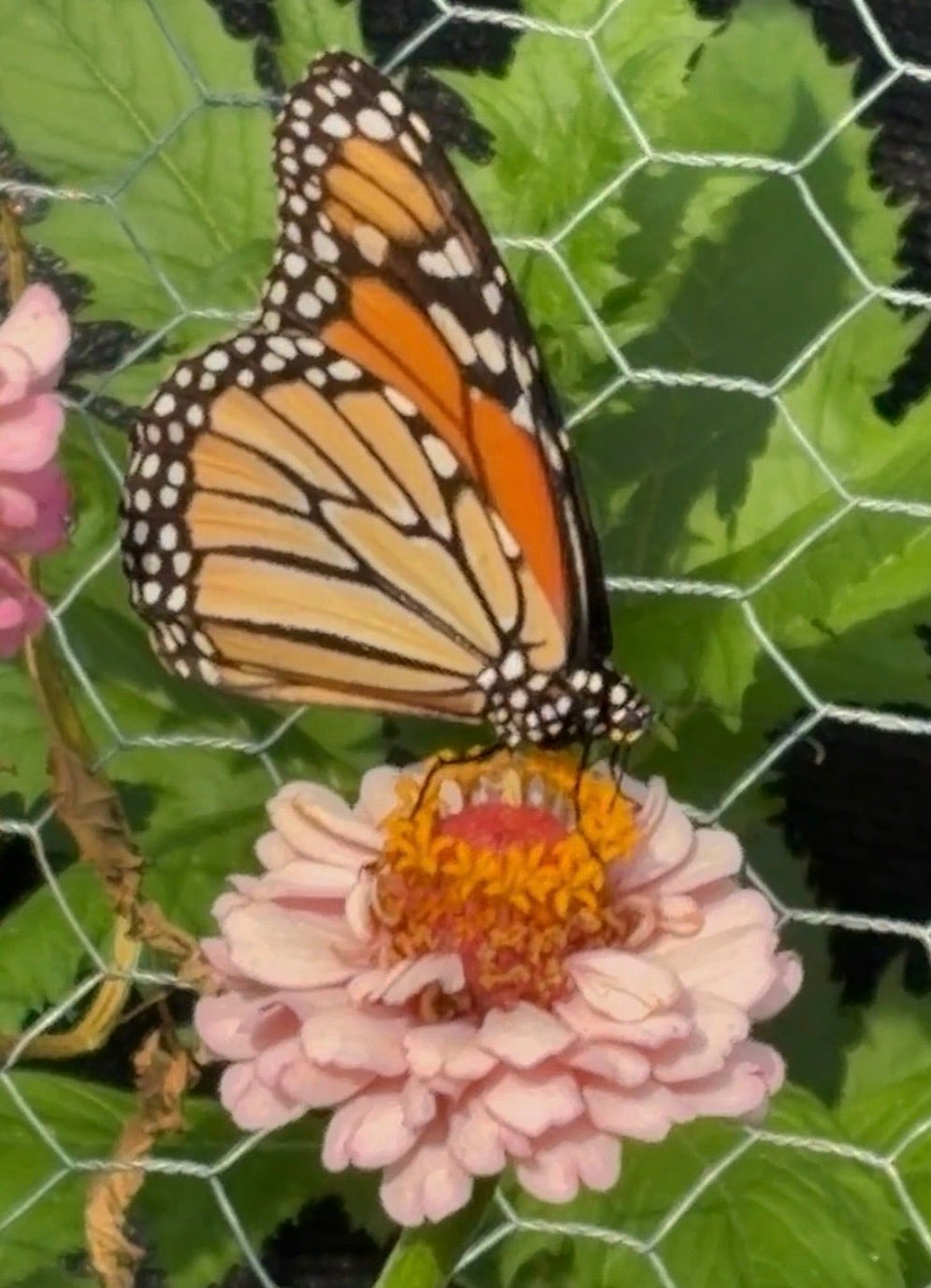
Within seconds, a monarch butterfly drifted past her, weaving through the towering sunflower stalks before gently landing on the golden eye of a dusty pink zinnia. Its large wings reminded her of orange stained glass with black veins and white spots along the edges. The butterfly uncurled its long tongue and drank.
Fransisca stood there in awe, appreciating the beauty in the ordinary. Maybe she herself was still just a baby caterpillar of a writer, and maybe that was okay.
July is when the garden goes from sweet and manageable to a zero f’s given wild jungle. It’s not holding back or staying small for anyone. It sparkles, blooms, and takes up space unapologetically.
The black-eyed Susans are putting on a show. Every single plant is in bloom, their yellow and red petals glistening as they soak up the sunshine. The snapdragons, while not as lush and vibrant as they were in June, are still trucking along, blooming and doing their best to produce seed. That is, if I don’t get to them first and deadhead them so they can produce even more blooms.
Foxgloves are standing tall, giving the garden fairytale vibes. Their purple, speckled tubular blooms are a bee’s tunnel of delight. But don’t let their beauty fool you. These plants are poisonous, which is why I don’t let our dogs in the enclosure and always wear gloves when handling them.
The dahlias, since they were started from seed, are slowly beginning to bloom. Each new flower is a surprise, and I never know what it’s going to look like until it finally opens. But their big moment usually comes toward the end of summer.
The celosias are my rule breakers. Their unique velvety blooms look like they should only exist underwater. They are so strange and beautiful that they have officially become my witchy flowers.


The stars of the garden this month... drumroll please... zinnias and sunflowers.
The sunflowers follow the sun, soaking in its warmth only to cast it right back out, lighting up me and the rest of the garden. While I devoted an entire raised bed to dwarf sunflowers, a few taller volunteer varieties found their way into the garden, growing so tall they’ve reached the roof of the enclosure.


Zinnias are the rainbow scattered across the entire garden. Their blooms are like bursts of fireworks, displaying every color imaginable in so many different shapes and sizes. They are my favorite flower to grow. Most of my zinnias are Floret Originals, and I find every single bloom stunning. If you’re unfamiliar with Floret Flower Farms, I highly recommend checking out either their YouTube channel or their TV series on Magnolia Network. Truly inspiring.


Let’s not forget about the Triple B.
Bees. Birds. Butterflies.
The garden has become the local hotspot for the Triple B. The goldfinches and sparrows squeeze their way through the quarter-sized chicken wire and devour the zinnias, plucking at the petals to get to the seeds. Soon their attention will turn to the fresh sunflower seeds.
The monarch butterflies drift through the garden, gracefully landing on the zinnias to sip their sweet nectar.


Oh, and the bees.
I’m so proud of myself for creating a sanctuary for them. There are so many different species, from tiny sweat bees to carpenter bees. Some come to work, pollinating everything, including my cucumbers, peppers, and tomato plants. Others come to live out their final days in our garden, burrowing into the wooden posts, laying their eggs before they inevitably die.
And then there are my favorite, the bumblebees. Have you ever seen a fuzzy bumblebee covered in pollen taking a nap on a flower? It’ll melt your heart.
To think about how poorly they’re treated breaks my heart. Remember, we need the bees.


While the garden is beautiful, it’s also been one of the hottest months of the year, so my garden tasks have been based on priority. Watering had to get done, and so did deadheading. But a lot of the weed pulling slowed down because, let’s be real, no one wants to do manual labor outside in 100+ degree weather.
And if you’re like me, I tend to wear pants and a jacket as armor against the blood-sucking fuckers, mosquitoes. The one time I went out there with shorts on, they all attacked me at once. It was like one got a taste and then sent out a signal: Fresh meat over here! Hurry!
It was horrible. I think I had like ten bites.
So if anyone has any non-toxic remedies for mosquitoes, please let me know. Until then, I’ll keep throwing on my mosquito armor because, as much as I complain, watering is one of the most important garden tasks this time of year.
Garden Tip #1: Water your garden either early in the morning or in the evening. This helps reduce water evaporation and allows the roots to drink deeply. When it’s extremely hot, you may need to water twice a day. Overwatering is also possible, so if Mother Nature provides the garden with rich, nutritious water, there’s no need to water that day. Of course, if you’re unsure, check the soil first.
Unfortunately, not everything was sunshine and rainbows in the garden. Toward the end of the month, my worst nightmare showed up, powdery mildew. It’s a fungal disease that appears as white, powdery spots, and if left unchecked, it can weaken a plant and eventually kill it. And this disease spreads quickly.
I actually wrote a horror short story about it last year called The Quiet Decay if you want to check it out.
This year, it started with the dahlias. I trimmed off as many diseased leaves as I could, but it was already too late, and I’ve since seen powdery mildew appear throughout the garden.
I will admit, I’m a bit bummed that I probably won’t get to see the dahlias in full bloom this season because of this. This is my third year growing dahlias, and I have yet to have a successful season. I’m not sure what I’m doing wrong, and if I’m being honest, I may not try growing them next year. We’ll see, though.
Garden Tip #2: When powdery mildew appears in the garden, trim off all diseased leaves and throw them away. Don’t leave them in the garden or compost pile. To help prevent it, you can also remove the lower leaves on plants to improve airflow. Treating plants with organic fungicides like neem oil or copper fungicide can also help. Another way to reduce the risk is to give your plants plenty of space and avoid overcrowding so air can circulate freely.


Another lesson I learned this year is to move any volunteer sunflower plants out of the enclosure. I’ve planted tall varieties in past years and always ran into the same issue, they grow too tall for the enclosure. This year I decided to grow dwarf sunflowers instead, but I couldn’t bring myself to remove the volunteer sunflowers.
Well, not only did they take over our coffin raised bed, stealing nutrients from the pepper plants and stunting their growth (I moved the pepper plants, btw, and they are loving their new spot), but the sunflowers grew so tall they tangled and twisted every which way before eventually pushing some of their buds through the chicken wire and blooming on top of the enclosure. Some of the blooms are squished up against the chicken wire roof as well.
Next year, the plan is to let the volunteer sunflowers grow until early June and then transplant them to the front of our house around our twelve-foot skeleton.
When I say the garden is a wild jungle I literally mean it. Plus it wouldn’t be an Armstina garden without something funky and weird about it.


The tangled mess of sunflowers is a great reminder that sometimes growth and chasing our dreams isn’t straightforward or neat. We’re going to hit roadblocks and detours, but if we keep at it and stay flexible with the work and how we get there, eventually we’ll reach our blooms. The journey rarely looks the way we imagined, but sometimes the most beautiful things grow from the plans we didn’t make.
The volunteer sunflowers may have grown in an environment that wasn’t ideal, but they still found a way to bloom. Maybe there’s a lesson in that too.
Until next month,
Christina


One Last thing….
July was full of little moments of magic, and I wanted to share a few of them with you. I hope you enjoy this little garden montage. Next up, August
Triple B, Baby!