MARCH
The posts leaned like old bones, their wood riddled with tiny holes. Chicken wire sagged between them, and last year’s debris spilled over the rusted raised beds. Brittle stalks bent under damp leaves, and a pale dust clung to everything like frost. The soil was cold and heavy, still holding winter’s damp. The air carried a faint sweetness of rot, a reminder that something had lived here once and would again. The holes in the posts were empty now, but she imagined bees sleeping inside, waiting for spring. Donnie called it an eyesore, but Marina ran her hand across the weathered wood as if it were treasure. At last, a garden of her own.
Marina and Donnie moved into their new house during the tail end of winter. Boxes crowded every corner, but while unpacking Marina caught herself daydreaming about the garden. Growing up in apartments, she’d been surrounded by her grandmother’s indoor plants but never had an outdoor space of her own. Now the garden was hers.
“I was thinking about setting up the nook upstairs as a little gardening area for myself,” she said, placing plates into the kitchen shelves.
“ Oh yeah? You do realize gardening is a lot of work. My parents had a small garden every year and it was like a part time job. Are you sure you can handle that? Plus that garden enclosure is falling apart. We’d be better off tearing it down and putting in a pool.” Donnie unwrapped another dish and set it on the counter with a thud.
“I don’t want a pool. The garden stays. And besides my boring accounting job what else I got goin on? I’m going to make it gorgeous, just wait.” She grinned as if daring him to argue.
Over the next six weeks, she turned the upstairs nook into her private greenhouse. A single skylight cut through the slanted ceiling, spilling light across wire shelves, grow lights, and a potting table. She planted zinnias, dahlias, marigolds, cosmos, and sunflowers, already picturing their colors crowding the garden come summer. Outside, she cleared the raised beds, hauling away the old debris and working fresh soil into the beds and pots.
MAY
It was planting day at last. Marina had counted down the cold weeks of April, as Midwest winters always seemed to drag on, waiting for the ground to be ready for her seedlings. She carried them into the garden along with her phone and a portable speaker. With her favorite Jessie Reyez album looping in the background, she knelt by the raised bed and pressed the fragile plants into the soil as if she were tucking children into bed for the night.
And then she heard it, the loud buzzing cutting through the music and growing louder with each second. Pausing the song, Marina stood and circled the garden, searching. To her, it was the truest sign that gardening season had begun. Sunlight glared into her eyes, blurring her view until she slid her sunglasses into place. A sharp hum zipped past her head. She spun, and there it was…a carpenter bee burrowing into the post, carving new holes. Her lips curved up into a smile. In silence she watched it work, hope rising in her chest. A new season had begun.
JUNE
The garden was alive now, green foliage spilling from the raised beds, buds swelling, and some already in full bloom. Bumblebees and carpenter bees drifted from flower to flower, devouring the pollen. Every day after work, Marina walked through the garden, noting even the smallest change in each plant. But not everything had survived. A few seedlings had shriveled without explanation. She blamed bad seeds, tugged them out, and tossed them into the plastic bin she kept for debris. Life outside the garden started to feel heavy, especially at work.
“Marina, I need those checks cut and sent out as soon as possible. Also, did you send the aging reports?” her boss asked as he walked past without looking at her, disappearing into his office.
“On it now,” she said quickly.
Bing. Bing. Bing. Emails lit up her screen — invoices, a reimbursement check, more follow-ups. The other accountants whispered back and forth, gossip spreading through the office like smoke. She tried to block it out, but it was impossible not to listen. Everything blurred together until she couldn’t tell what the priority was. Her leg bounced under the desk, heart racing to the same rhythm. Tears built up as she listed everything in her head. Checks. Aging reports. Reimbursements. Invoices. Checks. Aging reports. Reimbursements. Invoices. She stared blankly at the screen, one hand steady on the mouse, fighting to keep the tears from falling.
As soon as five o’clock came, she logged off and rushed home. She hurried to the garden as if she’d been holding her breath all day. Work had filled her lungs with carbon dioxide, and only here could she breathe again. For the first time all day, a smile tugged at her face as she noticed the new zinnia blooms. She plopped down on the gravel beside the sunflowers. In the quiet, she just listened: birds chirping, bees buzzing, geese squeaking as they flew overhead. For a minute, she let herself daydream. Feeling so accomplished with the garden, she began to wonder if this could be more than a hobby. She could grow flowers and open a small floral shop. What a life that would be, one full of beauty every day. Now that was a dream.
JULY
The skies had turned restless. Storms rolled through one after another, pounding the garden with heavy rain and splitting the air with lightning, thunder rumbling under her feet. Marina stood at the window, counting the seconds between the flash and the thunder, her plants trembling under the downpour. She watched the dahlias and sunflowers sway, worried their stalks would snap. After days trapped inside, she was growing restless.
Donnie came up behind her and wrapped his arms around her waist. “Looks like it’s going to storm all weekend. Should we order pizza and watch a movie? You can pick.” His voice was light, coaxing.
“Yeah, I guess. I don’t even know what’s out. You pick.” She sighed, pressing her forehead to the glass. “I need the distraction anyway. I’ve been so nervous about what the storms might do to the garden.”
“How about Bram Stoker’s Dracula?” he grinned. “You’ll love the cast and you’ll love that it’s set in the 1800s.”
Warmth filled her chest. She turned, kissed him, and nodded yes.
By Monday the storms had passed. She’d spent the whole day at work daydreaming about cutting fresh flowers to bring inside. To her surprise, none of the dahlias or sunflowers had snapped. Everything looked untouched, as if the storms had never come. She slipped on her gardening gloves, grabbed her scissors, and started cutting zinnias. As she trimmed away the leaves, a puff of dust flew into her right eye.
“Fuck,” she muttered, blinking hard. With her hands full, she kept the eye shut and tried to finish quickly. That was when she noticed the faint white specks on the leaves. She tried to fight through the pain but couldn’t take it any longer. Finally, she hurried inside, rinsed it with water, and used eye drops until the pain dulled, leaving her eye pink and raw.
After eating dinner alone, she sank onto the couch, scrolling TikTok without thinking. More innocent people being detained by ICE. A school shooting. Breaking news, breaking news, breaking news. Each swipe heavier than the last, the screen’s light flickering against her blank stare. She lost track of time until Donnie’s voice cut through the noise.
“Marina… Marina. Hun.” Louder each time.
“What?! What do you want?” she snapped, dropping the phone onto her lap.
“Everything okay? I noticed the eye drops in the bathroom. Your eye looks a little pink.”
“I’m fine. Just some dust from the garden. It’s not a big deal.”
“You seem stressed. Something happen at work? Did I do something?” His concern grew with every question.
“Oh, you know. Just the impending doom of this country. And yeah, work fuckin sucked. I’m tired. I’m going to bed.”
She went upstairs without waiting for him. Sleep never came, only the sting in her eye and the crawling thought that something was waiting in the dark.
AUGUST
By August the garden should have been in its glory, colors bursting from every bloom. But the leaves had lost their shine, their green dulled to a weary matte. The air hung thick, heavy with the smell of damp soil and something sour underneath. Then came the white spots, spreading across the leaves, dulling their colors. That night, as Marina changed for bed, she caught a glimpse of her arm in the mirror as she scratched it aggressively. A pale patch stared back at her, shaped like the leaves from the garden. Her eczema must be back, she told herself. She rubbed on lotion and turned off the light.
Morning came not with a sunrise but with a heavy gray cloud that seemed to have been waiting for her. The first thought that greeted her was a smog of failure pressing against her chest. What did I do wrong in the garden? she wondered. She replayed every step in her head, searching for the mistake that could have caused the spots. Without leaving the bed, she grabbed her phone and typed: why are white spots spreading on plants. The screen filled with results, all pointing to the same thing: powdery mildew. A fungal disease that spreads quickly.
That afternoon Marina was determined to try every remedy she’d read about. Cut off infected leaves. Apply fungicide. So she went plant by plant, stripping the dahlias, then the zinnias, then the sunflowers. By the time she was done, a pile of leaves lay at her feet, pale and spotted, like scraps of diseased skin. She emptied two bottles of fungicide Donnie had picked up for her that morning, drenching what remained.
Her phone buzzed as she gathered the pile. She let it ring several times before finally answering, already annoyed.
“Hello.”
“Everything’s going to shit. Nice turn signal, asshole! Hello. Have you talked to your sister? I’ve been trying to get ahold of her for days,” her mother’s voice snapped, chaos spilling through the phone.
“Nope. Haven’t talked to her all week. She’s probably busy with work and the girls,” Marina said, already moving to defend her sister.
“Well, tell her to call me.”
Beep. Beeeeeep. “Green means go! Dumbass!” her mom yelled away from the phone. Then, without pause: “So I heard you’re thinking about quitting your job to open a flower shop. You’re not serious, right? Your sister said it as a joke, right?” She laughed, sharp and dismissive.
“I’m not doing anything right now, but yes, I was toying with the idea.”
“Don’t be an idiot. You have a steady job with decent pay. In this economy, you’re lucky to have what you have.”
“I know, it was just an id—”
“That’s your dad calling me. Let me call you back.” The line went dead.
She dropped her phone onto the garden table, harder than she meant to. The words don’t be an idiot echoed in her head. The pile of diseased leaves at her feet seemed to mock her, proof that her mom had been right all along. Useless. Hopeless. A joke. She craved alcohol like she hadn’t before, needing something, anything to take the edge off.
Leaving the mess behind, she hurried inside. “I’m running to the store. Be right back,” she called to Donnie. As she pushed open the back screen door, something in the glass caught her eye. A pale patch spread across her chest, ghostly against her skin, as big and round as a sunflower leaf. Heat rash? No. Heat rash burned red. This was something else, and it looked wrong. Her anger wouldn’t let her linger on it. She shut the door hard and headed for the store.
The Trader Joe’s parking lot pulsed with chaos. Cars circled like vultures, hunting for spots, while others idled with their turn signals clicking in impatient rhythms. Shoppers zigzagged through traffic, arms full of bags, as if they were trying to outrun the madness. Marina spotted a car backing out and accelerated into the space, cutting off the driver who had been waiting patiently. The driver leaned on the horn, but she didn’t care. Sliding on her sunglasses, she stuck up her middle finger and walked toward the store.
The store was no better. Every aisle was overcrowded with workers stocking shelves, carts blocking the way, and kids staring at their phones and iPads as they drifted aimlessly while their parents shopped. Marina didn’t bother looking around for anything but beer. She power-walked, weaved through the crowd, and headed straight to the back. At the display, a young couple stood chatting in front of the stacked cases. She didn’t want to be in the store a second longer than she had to. Just grab the beer, any beer, she told herself. Without a word, she slipped between them and snatched a four-pack, then made her way toward the registers.
The lines crawled. Tapping her foot impatiently, she scrolled TikTok. Video after video showed blooming gardens, all bright colors and perfect flowers. Each one made her more restless. Finally, she leaned to the right and snapped, “What’s the holdup here?” No one answered. Just a few mean looks tossed in her direction.
Back home, she dropped onto the couch beside Donnie and cracked open a beer, drinking it in less than two minutes.
“Woah. Are you okay? You usually don’t drink that fast. That’s probably the fastest I’ve ever seen you drink a beer our entire time together,” Donnie said, concern in his voice.
“Just needed something to take the edge off,” she muttered, already reaching for another.
She paused mid-sip. “I want you to look at something for me. Do you see the spots on my arm? And my chest?”
Donnie leaned in, squinting. “No. It just looks like a little dry skin.”
She didn’t reply. She just drank, phone back in her hand. She knew it wasn’t dry skin. She could feel it seeping into her, spreading, suffocating her from the inside out. By the time she finished the four-pack, she was doomscrolling in a haze, drifting into sleep on the couch, numb to her failures.
SEPTEMEBER
The garden was completely swallowed by powdery mildew. Every leaf wore a layer of white dust, as if a light frost had passed, though the air was still thick with eighty-degree heat. A few flowers still tried to bloom, but their petals were muted, as if a gray filter had been laid over them, draining out every trace of color. Marina stood among the ruined plants, still as a scarecrow, eyes glazed over. More pale patches had surfaced on her arms and legs, spreading like the mildew on the plants she could no longer control.
At her desk, Marina stared blankly at the screen, fingers moving across the keyboard as if she were entering invoices. She did this for ten minutes before her coworker approached.
“So, did you hear? Taylor quit. Today’s her last day,” Veronica said.
Marina kept typing nonsense, then slowly looked up without moving her head.
“Marina… did you hear me? Taylor quit. Operations is freaking out.”
“Smells like decaying flesh,” Marina whispered.
“What?” Veronica blinked. “Anyway, people are dropping like flies. Might need to start looking elsewhere before things get bad.” She went back to scrolling her phone.
“All life must end,” Marina said. “My time here is done. Tell everyone I quit.”
Then she stood, grabbed her purse, and walked out of the office.
Rushing inside to change after work, she stood in front of the mirror. More patches had appeared since the week before, spreading in uneven, leaf-shaped clusters. They dusted her skin, pale as chalk, fluffy to look at but dry to the touch. She ran her fingers across one, and a fine residue clung to her fingertips, like the powder on the leaves outside. No matter how much lotion she used, the skin cracked again, flaking in thin white lines. She stayed there for a while, brushing her hand over her skin, rubbing her fingers together, watching the powder drift to the floor. Something in her chest ached, a pull she couldn’t name. The garden needed her. Or maybe she needed it.
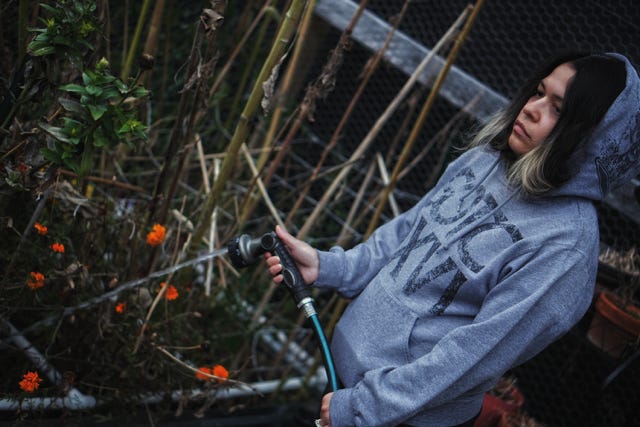
By the time she stepped outside, the sun was starting to dip, bleeding through the clouds in a pale amber haze. The air was thick and still. She picked up the hose and began watering what was left of the garden. The soil turned to mud around the roots, but she kept going, her blank eyes fixed on the wilted stems.
“Hey, hun. What are you doing home so early?” Donnie asked as he approached the garden.
Marina slowly turned her head toward him, still watering the plants, but said nothing.
“Marina? What’s going on?” His voice wavered with concern.
She didn’t respond. The water kept running. Donnie reached out and grabbed her arm to get her attention, panic in his touch.
“Marina, talk to me. You’re scaring me.”
“Oh… I… um… quit… my job,” she whispered.
“You what? Why? You really shouldn’t of done that without talking to me. We just bought this house.” He shook his head, frustrated.
Marina turned back to the plants and kept watering them.
“Marina, that’s enough water. The garden’s basically dead,” he said, backing away toward the deck. “Please, just come inside.”
He went inside, the screen door slamming behind him. Silence settled over the yard. Marina didn’t move. The hose slipped from her hand, snaking at her feet as water spilled into the mud. She watched it pool around her shoes, soaking through the fabric, but she didn’t step back. The air hung heavy, sweet with rot. Somewhere beneath the surface, something was still growing.
OCTOBER
The garden rustled in a papery whisper with each gust of wind. A sepia haze, coated in a thin layer of white dust, had overtaken everything, leaving no trace of green. The sunflowers, once proud and tall, bowed their heads in final surrender. The zinnias had turned parchment-like and brittle, their stems folding in on themselves. A faint scent of must lingered in the air. Everywhere she looked, the garden was dead, yet loud with all of Marina’s failures. Marina stood among the ruin, the hose in her hand again. Water trickled over the dead stems, soaking the dirt until it bled into pale streaks of mud. She couldn’t remember turning the spigot on. She just knew she had to keep watering.
She spent most of her days of unemployment sleeping, doomscrolling, and watering the garden. She lived in the same faded sweats, the fabric soft from wear, hiding the pale patches beneath. Hours passed without meaning. She was on the couch, scrolling through her phone, not even remembering what she read or watched, when Donnie came home from work. Their conversations had grown shorter, thinner, fading like background noise.
“Hey. Apply to any jobs today?” Donnie asked as he cooked dinner for the two of them.
Marina didn’t answer, just nodded no. She kept scrolling as he walked upstairs to take a call. After a moment, she paused, listening.
“Of course she doesn’t know.”
“I can’t wait any longer.”
“Meet me tonight.”
Heat rushed through Marina, a knot settling deep in her stomach. This fucker is cheating on me, she thought. He might as well have killed us both. This is the end. For us. The thoughts looped in her head as she crossed her arms, waiting for him to come back downstairs. When Donnie finally did, Marina stood up fast to meet him at the bottom of the steps.
“Who were you just talking to?” she snapped.
“Just Javi. He invited us to his place this weekend,” he said, avoiding eye contact.
“Huh…” Marina pressed her lips together and raised them toward her nose, her eyebrows lifting. She turned and walked back to the couch.
After eating dinner in silence, Donnie left the table to clean up the dishes, leaving his phone behind. Marina glanced at it, then opened his recent calls. A name flashed across the screen—one she never expected to see. Kristen. Her sister.
He’s cheating on me with my sister. He’s cheating on me with my sister. He’s cheating on me with my sister.
She repeated it over and over, as if trying to convince herself it was true, even as disbelief sank deeper into her gut.
“Hey, I’m gonna run to Jewel real quick. We’re out of milk,” Donnie said, breaking through her spiral. He grabbed his phone and keys and headed out the door.
Marina curled her fists tight and slammed them onto the table. A small cloud of powder billowed into the air. Her heart pounded faster and faster, like a jackhammer in her chest. When she looked down, her hands were covered in pale patches. Too angry to care, she stood and walked toward the back door. Just as she reached for the handle, a flash of movement caught her eye. Her reflection stared back from the accent mirror. Her entire face was engulfed in the same dry, fluffy white dry patches.
Moments later, she was in the garden again. The night was still, the air heavy and dark. The hose hissed softly in her hand as she watered the dead garden, her eyes glazed and unfocused. The water pooled around the lifeless stems, seeping into soil that could no longer take it in. She felt the patches permeate through her body every time she watered, but it didn’t stop her. Some part of her believed the garden still needed it, that without her, even the mildew might die. Footsteps approached, the crunching of dry leaves breaking the silence, but she didn’t flinch. The voices came next, low at first, then clearer with each step.
“I need your help to talk some sense into her. She hasn’t been herself lately.”
“She doesn’t always listen to me, you know, but I’ll try. Is she that bad?”
“Shhh. Do you hear that?”
“Hear what? All I hear are the damn planes flying over us.”
“It’s Marina. She’s watering the dead garden again. I swear to God, I’m going to tear this enclosure down tomorrow.”
“Let’s talk to her first, see what’s going on. I know my sister. She may just need someone to talk to, maybe a therapist or something.”
“Marina,” Donnie called out.
Heat swelled beneath her skin, thick and pulsing. The pale patches rippled faintly, rising and falling like they were breathing. When she moved, flakes drifted from her arms, soft as ash, revealing something raw and pink beneath. The air smelled faintly of rot and earth. She wasn’t sure if it was coming from the garden or from her.
Donnie and Kristen stepped into the garden, switching on the flashlights on their phones for light.
“Marina! I called for you. For fuck’s sake, why are you watering this dead gar—”
Before he could finish, she swung the hose at his head, knocking him unconscious.
“Oh my go—”
Marina grabbed the shovel and brought it down against the side of her sister’s temple. She sent her sprawling.
Marina stood over their bodies, motionless, watching as blood oozed from their heads. Then she heard it, the low familiar buzzing. A smile spread across her face as the carpenter bees drifted over the bodies.